Factors in TV-ads Techniques for Improvement of Viewer Recollection
Hironori Yoshida
Research on TV commercials has usually been performed with a view to advertising effectiveness. Because commercials reflect social trends, they have also become the subject of researchers in the fields of information studies, human engineering and viewer psychology.
However, such research is generally not reported to those who are in charge of directing the visual elements of the commercials.
So it is important to get the input of such creators and clarify the relation between the impact of visual expression techniques (which is meant here to include psychological reactions) and product and brand recognition from the viewpoint of the advertising creators and directors themselves.
How can the creator's expression technique in the production process influence and improve the viewer's recognition of a particular product and commercial.
The purpose of this research is to find new techniques in the production process which the creator or producer of TV commercials can use to cause a higher level of viewer recognition.
To that end, three kinds of visual experiments based on cognitive psychology were conducted.
The elements in this study were limited to standard expression techniques such as "fade-in" and "wipe-in." Fictitious products were labeled in Japanese with nonsense names such as "Teyu," "Nuha" and so forth for external shots.
◦ Introduction Techniques For Product External Shots
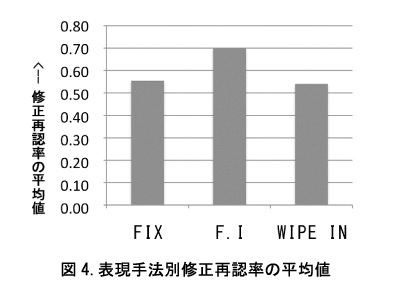
Three kinds of techniques were used to establish recognition of the product.“Fade-in” was found to be more effective than “Fix”and Wipe-in for recognition.
◦ Expression Techniques for Commodity Label Shots
Three kinds of techniques were used to establish recognition of the product. Three kinds were “fix”, “panning”, and “zoom-in”. “Fix” is the simplest expression. “Panning” is active expression “Zoom-in”. As a result, “fix” was more effective than “Panning”.
◦ Differences in Expression Techniques Regarding Story-Related Shots
Shots focusing on story elements were investigated to discern whether they could improve viewers' favorable impressions of the commodity. The circumstances of the story shots were indeed found to affect favorability.
The question can be posed whether the goal of television advertising to create product recognition or product favorability. It can be said in answer that favorability is a major premise in improving product recognition.
Much attention is paid to measuring TV commercial effectiveness these days. However, it
is focused only on the content of completed TV ads and becomes merely a reference point for the next ad campaign. What should be sought in marketing strategy is ways to improve product recognition in ongoing TV ad campaigns. Even though viewers may not concentrate on what they are watching, TV commercials are a unique communications tool that can have a huge influence and effect on consumer behavior. This study seeks to uncover new ways of using that tool.
||||||||||||||||||||||||||||||||||||||||||||||
1.研究内容
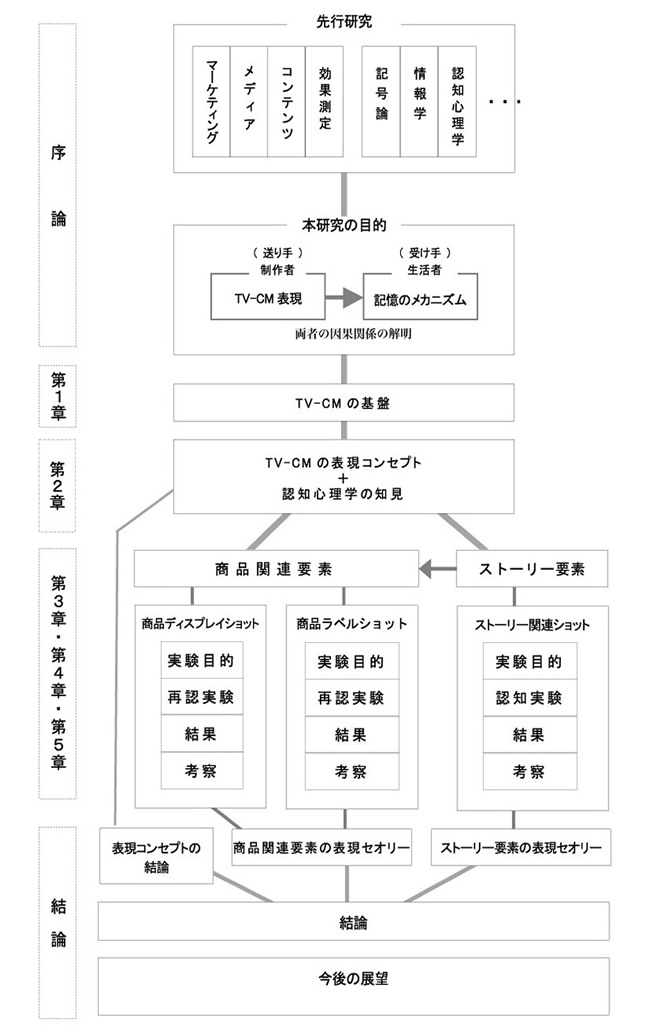
本研究の構成は、研究の背景と目的に言及した序論からはじまり、第1章ではTV-CMの構成要素を制作者の視点で設
定して、第2章では企画コンセプトと生活者の記憶との関係について、第3章から5章では、どのような表現手法が見る人の商品想起につながるか実験検証を行い、結論の章で、これらの実験から得た結論をもとに、効果的な表現手法について表現セオリーを導く。これらをフローチャートで表すと次のようになる。
|